Article
What is IT Operations Management?
Hello. This is JS Shin, a marketer at NKIA.
Going forward, I will explain various insights related to IT operations management in a way that is easy to understand.
The field of IT might feel difficult at first, but as you read through one by one, there will come a point where you naturally see the flow and find yourself at a level where you can understand and explain it on your own. From content that is helpful in practice to the latest trends, I plan to deliver stories centered around practical applications in the field, so please show a lot of interest.
Then, let's start with our first story, IT operations management.
Why IT Operations Management Matters
The IT environment has been changing rapidly in recent years. As cloud, containers, and various service architectures combine, systems are becoming increasingly complex. It is no longer enough to simply check if a server is running well. We must also manage whether services are being provided stably, how quickly failures are responded to, and how operational efficiency is maintained.
In this flow, IT operations management is moving beyond a simple management domain to establish itself as one of the core competitive advantages of enterprises.
What is IT Operations Management
IT operations management refers to the comprehensive activities of managing systems, services, and assets to stably deliver an enterprise's IT services. Put simply, it includes the entire process of checking whether services are running normally, responding quickly when failures occur, and efficiently managing IT assets.
Recently, these operational methods have been evolving rapidly beyond simple management levels into methods utilizing data-driven analysis and AI.
IT Operations Management is Divided into Three Parts
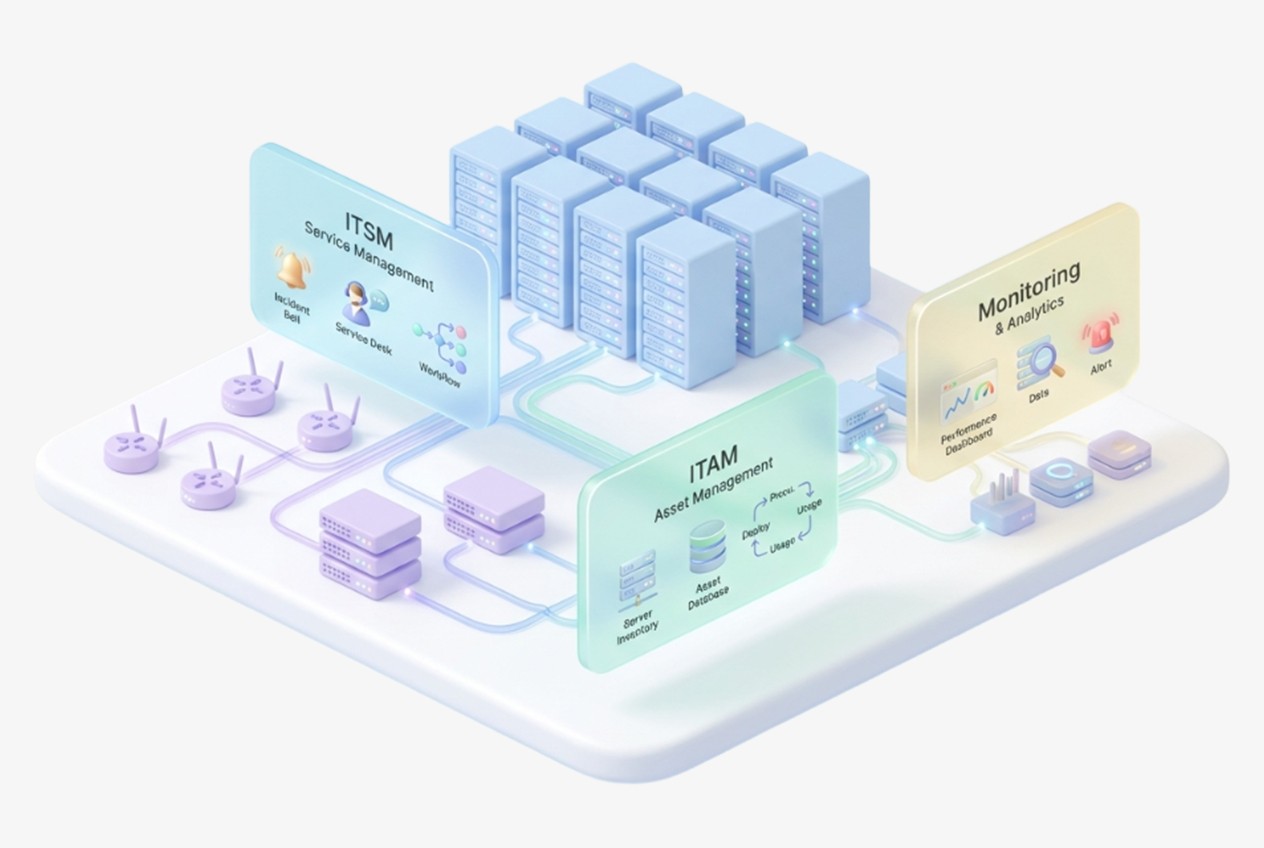
IT operations management can be broadly understood by dividing it into three areas: service management, asset management, and system monitoring.
ITSM, which is the service management area, is responsible for processes to stably deliver services from a user's perspective, such as incident response, problem management, change management, and service request processing.
ITAM, the asset management area, systematically manages IT assets such as servers, networks, and software from introduction to operation and disposal. Accurate asset management must be in place for the foundation of operations to remain stable.
Monitoring is the area that checks how the system is actually operating, playing the role of quickly detecting problems through server performance, network status, applications, databases, logs, and more.
Why Should We Look at These Three Together?
In reality, these three are often operated separately, but operating this way leads to several problems. Representative examples include situations where a failure is detected in monitoring but the processing flow is delayed in ITSM, or where the exact scope of impact cannot be grasped due to a lack of asset information.
In such a structure, failure response times are bound to be prolonged, resulting in a decline in service quality. Especially in structures where multiple systems are connected, such as cloud or Kubernetes environments, it is difficult to solve problems with individual areas alone.
Why Integrated IT Operations is Needed
The core of recent IT operations is integration. Analyzing based on service flows, looking at infrastructure and applications together, and linking with asset information to understand the impact is becoming increasingly important.
When such integrated operations become possible, failure cause analysis time is shortened, operational efficiency is improved, and service stability naturally increases. Furthermore, it is evolving in a direction that preemptively detects anomalies through AI-based analysis and reduces operational burdens.
Now is the Era of Operating as a Single Platform
In the past, service management, monitoring, and asset management were often operated as separate systems. However, today, it is shifting toward operating these three integrally on a single platform.
In this integrated environment, everything from system status to service impact can be grasped at once, enabling faster and more accurate operations.
IT operations management is no longer just simple system management. It is an integrated area that looks at services, assets, and systems together, and stable operation is only possible when each element is organically connected.
Future IT operations will change toward a faster and more efficient direction based on data and AI.
In the next post, I will explain the difference between monitoring and observability in an easy-to-understand way.
Author: JS Shin | NKIA Solution Consulting Team


