Article
What is AIOps?
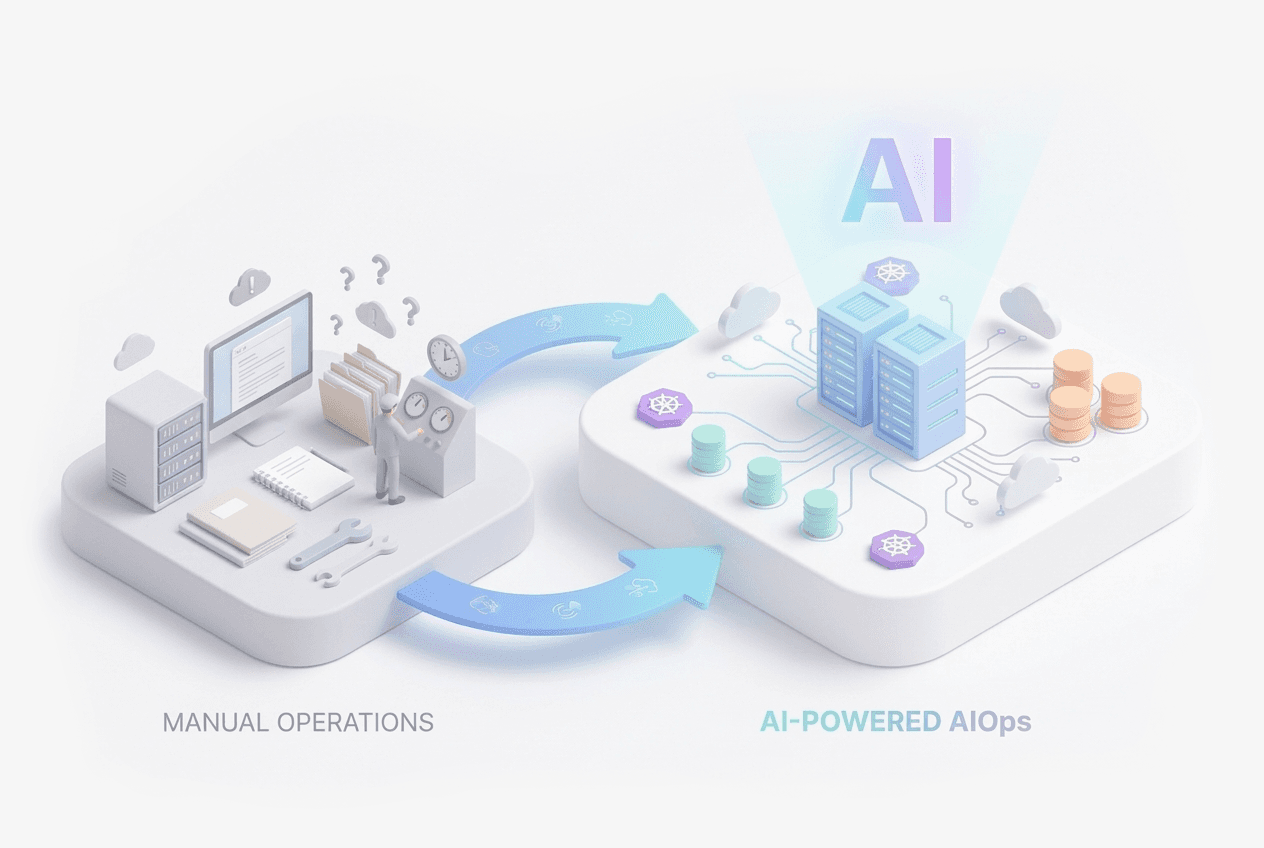
What is AIOps?
AIOps stands for Artificial Intelligence for IT Operations, referring to the approach of utilizing AI to automate and intelligentize IT operations. Simply put, it is a concept where AI analyzes and makes decisions on behalf of human operators, replacing the tasks previously performed manually.
For example, a series of processes such as automatically detecting failures, analyzing causes, and recommending necessary actions correspond to AIOps. It differs from traditional operational methods in that it goes beyond simply showing data and supports analysis and decision-making.
Why Has AIOps Become Necessary?
Recently, the IT environment has been changing rapidly, and its complexity is increasing significantly. With the expansion of cloud environments, MSA architectures, and Kubernetes-based services, structures where a single service operates across multiple systems have become commonplace.
In such environments, identifying the root cause of problems becomes much more difficult. Methods where humans check logs and make decisions based on experience, as in the past, hit limits in both speed and accuracy. Ultimately, a structure has emerged where the more data accumulates, the more difficult analysis becomes, and the burden on operations continuously grows.
The concept that emerged to resolve these limitations is precisely AIOps.
Limitations of Traditional Operating Methods
Traditional IT operations are mainly carried out by checking alerts, analyzing logs, and solving problems based on the operator's experience. This process not only takes a long time, but also has the issue that results can vary depending on the operator's level of proficiency.
Particularly in environments where multiple systems are complexly interconnected, it takes a lot of time to find the cause, and delays in incident response also occur. In this kind of structure, there are limitations to improving operational efficiency.
How is AIOps Different?
AIOps automates operations and intelligentizes the analysis process based on data. It comprehensively analyzes various data such as logs, metrics, and events, automatically detects abnormal patterns, analyzes causes, and presents results.
For example, it is utilized by detecting unusual traffic patterns, finding recurring anomalies in specific sections, and notifying users of potential failures in advance. This shifts away from traditional post-incident response-oriented operations to create an operational environment where proactive response is possible.
In addition, as the analysis process is automated, operators can focus on more important decision-making rather than simple verification or repetitive tasks.
Core Capabilities of AIOps
AIOps generally includes features such as anomaly detection, root cause analysis, automatic threshold setting, alert analysis, and automatic classification. Through these capabilities, failures can be detected faster, analysis time can be shortened, and operational efficiency can be enhanced.
In particular, by automating repetitive tasks, it reduces the burden on operators and supports them to focus on more critical judgments and responses. Consequently, improving both the speed and accuracy of operations can be seen as the core value of AIOps.
AIOps is not just a simple technology, but a trend that changes the IT operations paradigm itself. Now, IT operations are evolving away from manual human judgment toward automated analysis and response based on data.
In the future, operations utilizing AI will become a necessity rather than an option.
Author: JS Shin | NKIA Solution Consulting Team


